Do Anything - Do It Anyway
How do I remove pressure from myself?
How do I allow myself to create without being paralysed with the thoughts of my work never being good enough?
How do I write with the purpose of getting ideas, stories and parts of myself understood by others, the imaginations and thoughts that keep me up at night?
How do I exist beyond a being that ruminates on her existence?
The constancy of these questions is not what keeps me from writing. Neither is the inability to answer them. I know what the answers are. Those are constantly changing, too.
Sometimes, it’s the mere fact that I don’t want to be perceived. Or rather, if I am, then how do I control the perceptions of me as something more than what I am? But how can I when I sometimes think so lowly about myself that I want to ctrl-delete every piece of writing I’ve ever done; whilst other times, I’m shocked that I’ve managed to compose, then cleave, then finally string words together to sound, not only coherent, but decent.
Depending on the hour, day, or how much sunshine cracks through my curtains at seven-thirty in the morning, the perceptions I have of myself, that I project onto others, and that others project back to me, could be good or bad.
Humans are self-critical, self-loathing, insecure little beings. Incapable of self-acceptance, and criticism from others – the only way we can face the duality of it is by accepting that fact. We are full of contradictions.
Maybe I can be a paragon of that? Maybe I can live with that.
As most of the characters I’ve grown up adoring; the inspirational stories that have etched themselves into my psyche; the quirky, admirable, and even cynical, genuine traits in my loved ones – their complexities and humanness are a reflection and unification of someone who was just like me. We’ve shared/sharing the same quandaries.
Even if every day I create a smidge of colour on the canvas of my creation. Then at least I’ve created something wholly me—purely for myself, to myself. I exist.
“(I’m writing about the meagre minimum, adorning it with purple, jewels and splendour. Is this how you write? No, it’s not by accumulation but by stripping naked. But I fear nakedness, since it is the last word.)
Meanwhile, Macabea on the ground seemed to become more and more a Macabea, as if reaching herself.”
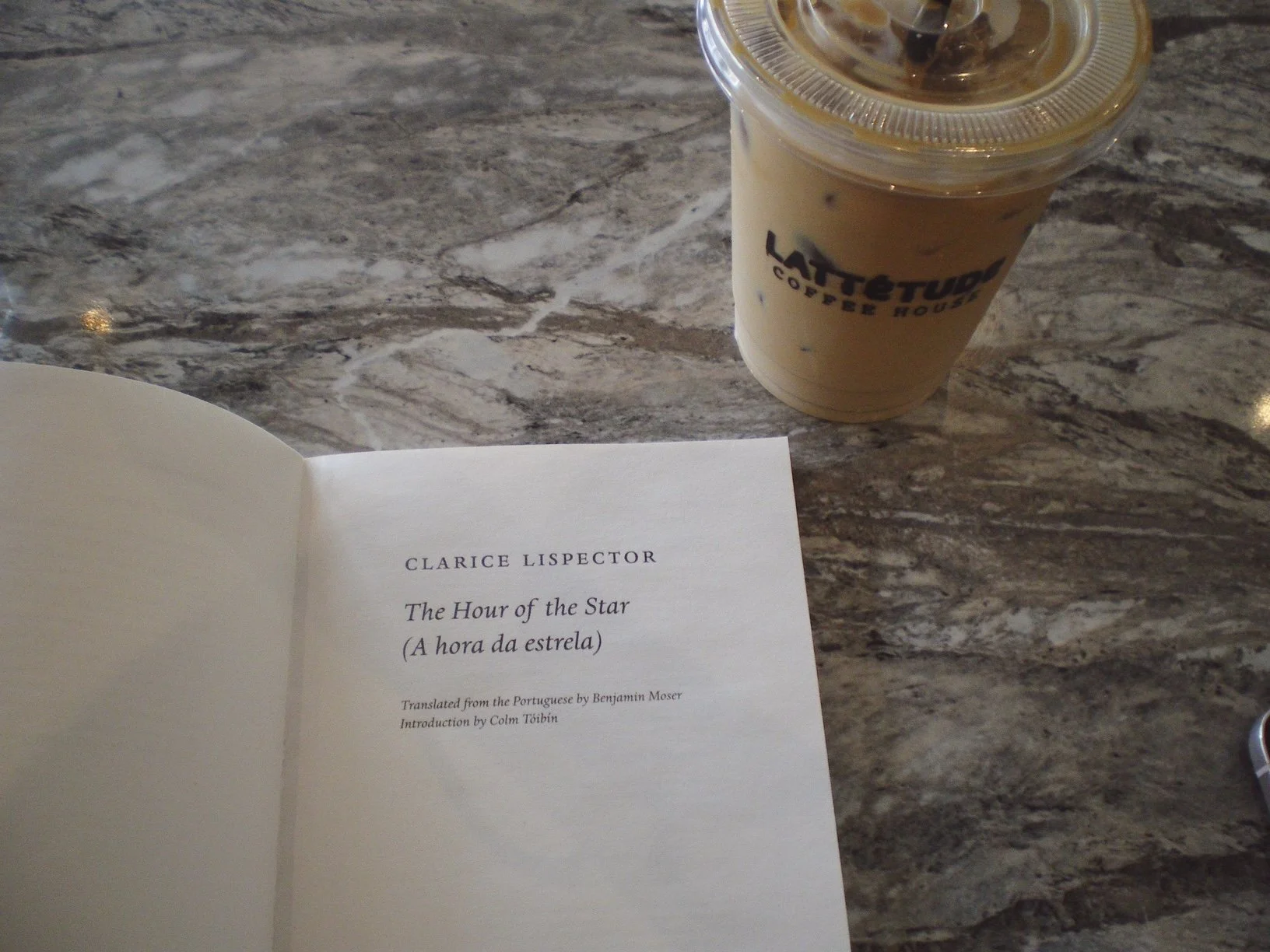
Since discovering Lispector’s novels last year, I’ve become besotted and perplexed by her brilliance. If you merged a lucid dreamscape with inescapable humanness – that’s where I’m transported to whenever I read anything by her.
Particularly, (through recency-bias) under the portrayal of Macabea, the ingenue in The Hour of the Star, and through Rodrigo SM, the narrative figure in the novel that presents us the character of Macabea. Many highlight the reflection of Lispector through Rodrigo SM. Through the narrator, I found myself forming a deep mutual understanding and connection, not only with the characters or Lispector but with myself.
This specifically spoke to me in the sense that, as a writer, we want to create something breathtaking, extraordinary, despite simply describing how ‘a blade of grass is blowing against a winter breeze’, we yearn to adorn that with splendour.
“Is this how you write?”
Rodrigo SM, are you threatening me? The markings on the side of old papers from teachers asking ‘Why’, ‘Explain’ have been triggered.
“No, it’s not by accumulation but by stripping naked. But I fear nakedness, since it is the last word.”
For that’s what it feels like to write. You’re baring your soul out in the open for anyone to gaze upon. To avoid convoluting, naked is naked – whether that be body, mind or soul. It’s uncomfortable. For an artist, a creative, a writer – it’s the only way we can grow. For “secrecy is a hotbed of vanity” (Brodsky’s, On Grief and Reason: Essays). If I can’t muster up the courage to write something terrible, then how am I going to ever know that I’m terrible, or god-forbid, even proficient enough, at putting words together?
If we can give ourselves a minuscule amount of grace and even an inkling of pride, then maybe we’ll be able to create something. We’ll be able to become more and more a version of ourselves that can reach ourselves.
Though those are just excerpts, I highly recommend Lispector and Brodsky for more thought-provoking, philosophic and psycho-social exploration.
If you’re able to relate to these feelings, there’s always hope that you can come back to your craft! You’re never alone. Even as I write this, I keep returning to the optimistic, delightful reminder that when I stop trying to be the best, I can finally be free to lavish in being the worst.
“Maybe disappointment is the fear of no longer belonging to a system. So I could put it like this: he is very happy because he is finally disappointed.”